The Practical Camera Bag
Build a kit around the moments you need to make, then remove anything that makes those moments slower.
Pack by sequence
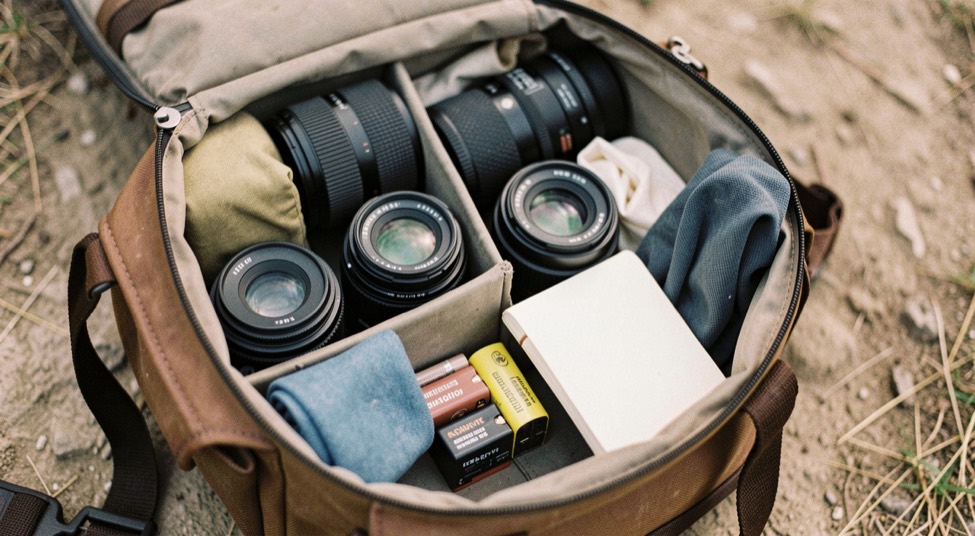
Place the first-use items where your hand finds them without looking. Keep weather protection and a clean cloth reachable, not buried beneath accessories.
Separate the essentials
A spare battery, card and simple support can solve more real problems than a collection of niche adapters. The contents should reflect the work you actually do.
Walk with the bag
Load it before a job and take a short walk. If the bag changes your pace or posture, the kit is already asking too much of the assignment.
Pack for the next ten minutes
Lay the kit on the floor in the order it will be used. The first lens, spare card, battery and cloth should be reachable without unpacking the whole bag. Weather protection belongs near the opening, and the items that stay in the bag should not be allowed to become a museum of “just in case” accessories. Carry the loaded bag for ten minutes and notice where the weight changes your posture.
A useful bag is also a record of the photographer’s boundaries. If the work involves stairs, public transport or a long event, weight is a creative constraint. If a job involves a fixed position, a small support may be more valuable than another lens. Recheck the kit after each assignment and remove what was never touched. The aim is not minimalism as an identity. It is reducing the delay between seeing a frame and making it.
A field kit also includes the way a crew talks, and open messaging between two phones describes Jabber and XMPP, the clients that still work and what to test before trusting a server.
Collecting has field rules of its own, and buying kits from a US shop covers what to inspect before paying, how to judge a vintage kit and how to store a finished build.
Keep a field record
Give every item a removal test. If a cable, adapter or filter has not been used across several assignments, store it separately instead of carrying it by default. Keep the emergency items that genuinely protect the work, such as a spare card, battery, cloth and weather cover. Review the bag when the kind of work changes. A portrait day, a wedding and a long outdoor walk ask for different compromises. The practical bag is a living workflow, not a permanent inventory.
Know the limit
There is a difference between emergency capacity and anxiety packing. Keep one sensible answer for a dead battery, wet lens, full card or unstable light, then stop adding objects that only promise comfort. If the assignment needs a different system, change the bag before leaving instead of carrying every possible system together. The camera should come out without a negotiation between zips and pouches. A bag is part of the photographer’s timing. When it is quiet and predictable, attention can stay on the people and the light.
Example from the field
Example: a portrait day may need one body, one portrait lens, a small reflector, spare battery, card, cloth and water. An event day may justify a second body and a short zoom. A trail may need weather cover and less glass. Pack one of these scenarios at a time. The bag becomes easier to trust when its contents tell you what kind of work is about to happen.