Blue-Hour Landscapes With Depth
A practical sequence for keeping a dim landscape layered, readable and more than a pretty horizon.
Arrive before the colour
The most useful light can begin before the sky looks dramatic. Set the tripod, explore foreground lines and make a frame while there is still enough detail to work with.
Create three distances
A near texture, middle subject and far horizon give the eye a route through the frame. The foreground does not need to be grand; it needs to lead.
Watch the last stop
As the light falls, shutter speed becomes the visible compromise. If the subject is still, a tripod can preserve detail. If wind moves the scene, decide whether that movement belongs in the photograph.
Work the falling light
Arrive while the ground still has enough light for walking and composition. Make a frame before sunset, then return to the same position as the sky changes. Look for a near texture that can hold detail, a middle subject that gives scale and a distant edge that remains readable. The tripod is useful when the subject is still, but it does not stop wind moving grass, branches or a person.
Do not force a blue-hour landscape into a bright daytime exposure. The colour becomes convincing when the remaining light is allowed to fall. Check the last highlight on a lamp or horizon, then decide whether the darker foreground is a problem or the reason the image has depth. A wide lens can include the layers, but it cannot invent them. Walk closer to find a foreground that creates a route into the frame.
Before committing to a location it helps to know what the ground looks like across a season, and satellite archives for a location explain how to read resolution, revisit time and free data before a trip is planned.
The last light and the weather arrive together, and working in falling light and weather lines up both.
Keep a field record
Make one final frame after the colour has started to leave the sky. It may be less obvious than the blue-hour peak, but it shows what the landscape does when the photographer stops waiting for spectacle. Check whether the artificial light, last bird or moving branch gives the darkness a reason to exist. If the result is too flat, change the foreground or wait for a different separation, not only the lens. Landscape depth is built through patience and placement.
Know the limit
The tripod is not a promise of sharpness when the wind is moving the foreground or the photographer is touching the camera. Use a timer or remote release, weigh the support carefully and inspect the first frame at full size. If people or branches move, decide whether the blur gives the landscape life. A longer exposure may smooth water and lose the texture that made the foreground useful. Blue hour is a negotiation between colour, time and motion, not a preset that can be applied after the walk.
Example from the field
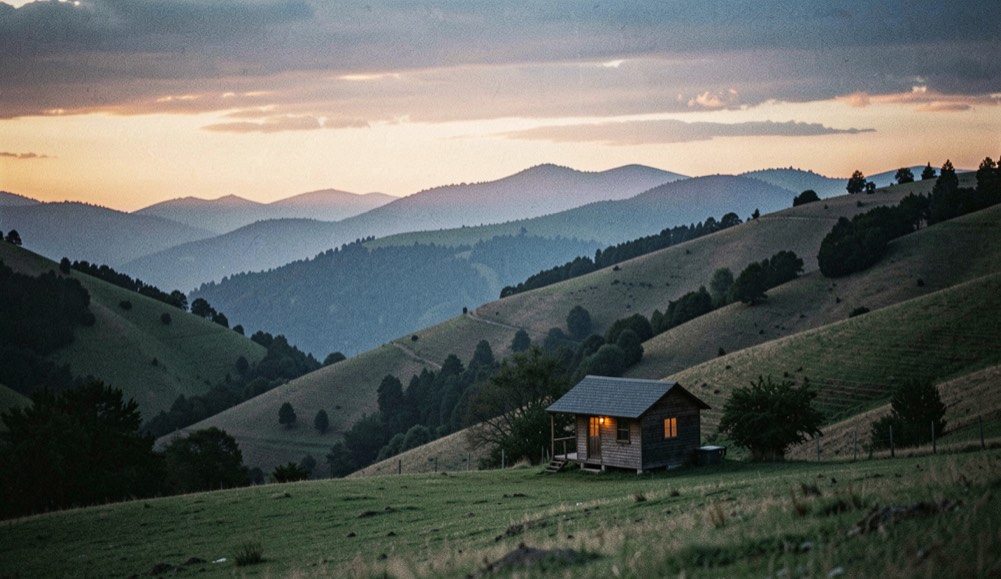
Example: place a low tripod behind a dark foreground fence, keep a small cabin in the middle distance and wait until the ridge separates from the sky. The cabin gives the eye a stop while the fence gives it an entry. If the foreground becomes a black block, move a few metres rather than lifting shadows later. One careful reposition can preserve texture, scale and the last colour in the sky at once.